 Handbook Home Page Table of Contents
Handbook Home Page Table of Contents
 Next Chapter (Color & Marking)
Identifying Silicon Graphics workstations and knowing what kind of interfaces they contain can be a difficult problem. It's the purpose of this document to help in that quest.
This document is organized so that information about the broad range of SGI systems is collected here in one document. Reading through the information from front to back will progress from general information about SGI systems to the more specific information about particular interfaces. Along the way terminology will be defined that will help in identifying systems, options and interfaces available. These definitions are also listed in the Lexicon of Terms.
This document covers all of the "4D", Mips RISC-based systems from the original 4D/60 to the Indy. The IRIS systems that contained Motorola 680X0 processors with model numbers like 1000, 1400, 2400, 3000 and 3030 are not covered here.
The major goals of this document are to allow you, the reader, to do two things:
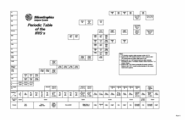
The term platform is used here to specify a particular set of three characteristics - the chassis the system is contained in, the number and type of processor(s), and the type of graphics subsystem (if any) the system contains. This aspect of SGI systems is seen most clearly in the Periodic Table of the IRIS's. A platform is the intersection of a graphics choice with a processor choice.
Inherent in determining the kind of machine is the use of one or more names. Machines are known by marketing names, engineering code names, or model numbers. Knowing what each of these names refer to will assist in defining the system in question. Names and their meanings are covered in "Terms, Nicknames and Code Names".
1.2.2 IRIS Family Tree
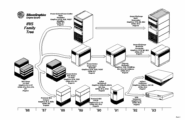
Another key element in understanding SGI platforms is knowing where, historically, these platforms belong. The IRIS Family Tree has been created to answer this need. This diagram shows each major new chassis and shows which processor and graphics types were originally shipped with it. The diagram shows the year in which the platforms first shipped. Click on the image above this paragraph to geta larger, postscript version of this drawing.
Silicon Graphics has become known for its use of bold colors on its products. This too, is a way to determine what might be inside the IRIS. Lately, badges have been used to reflect certain graphics options. The Color and Marking Chapter shows how to decode these colors.
Knowing what a chassis looks like and where to find a particular input or output connection can be a great advantage in working with the system. For each chassis particular attention is devoted to identifying each interface and a pointer to a detailed definition of that interface. The drawings in the Chassis Tour chapter will help you in finding the interfaces available.
The various interfaces available on SGI platforms are documented in the Interfaces chapter. This information is truly the heart of this document and the longest section. The interfaces are grouped in categories:
Some information about the system is not discernible from examining the outside of the system. To aid in gathering more information about the system the chapter on Software Tools was created. This contains information on commonly known tools, such as hinv, as well as some less well known tools that can help determine the exact configuration of the system.
Since terminology is so important, understanding the how to "decode" the internally used project names into the actual names used by Marketing is crucial. There are two reasons for this:
The tables below shows the relationship between the internally used code name, the marketing name and the model numbers for SGI systems for chassis, CPU's and graphics.
--------------------------------------------------------------------
   Chassis    Chassis Type  Marketing Name  Model Numbers
  Code Name
--------------------------------------------------------------------
"Twin Tower"  Twin Tower                    4D/60, 70, 80, 85,
                                            120, 210, 220, 240, 280,
""Diehard""   Single Tower  Power Series    310, 320, 340, 380,
"Predator"    Rack                          420, 440, 480

"Eclipse"     PI, TFLU      Personal IRIS   4D/20, 25

"Magnum"      TFLU          Personal IRIS   4D/30, 35

"Diehard2"    Deskside      Crimson         Crimson

"Hollywood"   Desktop       Indigo          4D/RPC

"Eveready"    Deskside                      Onyx, Challenge L
                            Onyx/Challenge
"Terminator"  Rack                          Onyx, Power Challenge XL

"Fullhouse"   Desktop       Indigo2         Indigo2

"Guinness"    Desktop       Indy            Indy

--------------------------------------------------------------------

---------------------------------------------------------------------------
     CPU      Description                    Marketing     Found In
  Code Name                                    Name      Model Numbers
---------------------------------------------------------------------------
"Lonestar"    First R400 CPU for 4D Systems  Crimson     Crimson

"Twin Peaks"  Enhanced Floating Point R4K    TFP         Power Onyx, Power
              CPU                                        Challenge, Power
                                                         Indigo2
---------------------------------------------------------------------------
------------------------------------------------------------------------------
 Graphics   Description                   Marketing       Found In
 Code Name                                  Name         Model Numbers
------------------------------------------------------------------------------
"Clover1"   Original 4D Graphics          B, G         4D/50, 60, 70

"Clover2"   2nd Generation 4D Graphics    GT, GTX      4D/70, 80, 85,
                                                       120, 210, 220, 240, 280

"Stapuft"   3rd Generation 4D             VGX, VGXT    4D/310, 320, 340, 380,
            Graphics                                   420, 440, 480

"Venice"    4th Generation 4D Graphics    Reality      4D/310, 420, 440, 480,
                                          Engine

-           Original PI Graphics          B, G         4D/20, 25, 30, 35

-           Turbo PI Graphics             TG           4D/20, 25, 30, 35

"Da Vinci"  24 Bitplanes, No Z Buffer                  4D/20, 25

"Starter"   Original Indigo Graphics      Entry        Indigo R3K, R4K
                                          Graphics

"Express"   Family of 2nd Generation      XS, XS24,    Indigo R3K, R4K,
            Indigo Graphics               XZ, Elan     Indy (XZ only)

"Ultra"     High End of Express           Extreme      Indigo2
            Graphics Family

"Newport"   Original Indy Graphics, Low   XL           Indy, Indigo2
            End Indigo2 Graphics
------------------------------------------------------------------------------
A more lengthy lexicon of terms used to identify IRIS systems is provided as an appendix. This lexicon includes the Marketing terminologies as well as the Engineering terminologies. As is often the case, products are created long before their commercial name is chosen. Even after a product has been announced and has been shipping, members of the team who created it still refer to it by its "code name". Indeed some of these code names are used as nomenclature for various software and hardware pieces. Not knowing what code name equates to a "real" name is like being lost in a foreign land without a magic decoder ring. Hopefully this will help.
It would be ideal if it were possible to outline every possible combination of chassis, processor and graphics that ever existed. While tempting, this is not realistic. During the history of the IRIS systems, and primarily due to the modular nature of our graphics & processor subsystems and many upgrade programs, the markings on the outside of an IRIS may not actually reflect what is inside.